The multifunctionality of Papiamentu pa and its similarities with Brazilian Vernacular Portuguese

The multifunctionality of Papiamentu pa and its similarities with Brazilian Vernacular Portuguese

Marco Aurelio Schaumloeffel
Presentation at the ACBLPE (Association of Portuguese and Spanish-Lexified Creoles) Annual Meeting. Stockholms Universitet. Stockholm, Sweden. June 13-15, 2017
Conference programme
Conference website
Abstracts (pages 24-25)
References

Abstract

The multifunctionality of Papiamentu pa and its similarities with Brazilian Vernacular Portuguese

The Papiamentu (PA) lexical item pa can cover several functions, operating as preposition, mood marker and complementizer. Its functions actually clearly exceed those of its equivalent Portuguese lexical item para, not only covering the semantic load of para, but also that of por and a. An equivalent multifunctionality for this lexical item can also be found in other Portuguese-based creole languages like the Upper Guinea Portuguese Creoles (cf. Jacobs, Origins of a Creole) and the Asian Portuguese creole Papiá Kristang. When analysing the PA lexical item pa, Lefebvre and Therrien (On the properties of Papiamentu pa: Synchronic and diachronic perspectives, 2007) establish that it can perform fifteen different functions. Out of those, they only find five that have an equivalent realisation in current standard Portuguese. Lefebvre and Therrien believe that PA pa is derived from Portuguese para, and that its other properties would be derived from corresponding lexical entries in the PA substrate languages, more specifically from the properties of the Fongbe preposition and complementizer nú, and the mood marker and complementizer ní. However, when Brazilian Portuguese, and especially Brazilian Vernacular Portuguese (BVP) is considered, the degree of equivalence with the PA functions of pa changes dramatically. The aims of this presentation are to show the high degree of similarity that exists between PA and BVP when it comes to the functions of PA pa, and to make considerations as to why this sharp discrepancy exists if compared to the results found by Lefebvre and Therrien for current standard PT. Apart from that, the secondary aim is to ponder why this multifunctionality and equivalence in some functions can also be found in Papiá Kristang, a Portuguese-based creole from another branch that is knowingly not directly related to PA or to the West African Portuguese-based creoles.


Translating the Presence of Portuguese in a Caribbean Creole

Translating the Presence of Portuguese in a Caribbean Creole. Why are there similarities between an Asian Portuguese Creole and Papiamentu?

Marco APicture. Schaumloeffel

Presentation at the Translating Creolization Symposium – May 27-29, 2015. The University of the West Indies, Cave Hill Campus, Barbados

Website of the event: www.cavehill.uwi.edu/fhe/lll/tcs


Abstract
Papiamentu (PA) is a creole spoken as main language by the majority of the population in Aruba, Bonaire and Curaçao, and is official language in the first and in the latter. The origin of PA is controversial; a group of scholars attributes it to Spanish, due to its current lexical and phonetic similarities with Spanish, whereas another group sees linguistic genetic ties with Portuguese.

The aim of this presentation is to investigate the historical and linguistic links that might connect PA to Portuguese. Whereas historical links set the stage for eventual ties, possible grammatical commonalities in the very fabric that makes up the structure of PA may be strong indications of a genetic connection to its ancestor. Recent historical and linguistic evidence suggests that PA owes its origins to the West African Portuguese creoles. To further strengthen this evidence, this presentation will analyse key grammar elements such as function words, relators, verbal system and Time-Modality-Aspect markers, which are core elements and very strong indications of genetic ties, given their very low borrowability in contexts of relexification and formation of creoles. The analysis is done by means of comparing these PA core elements with those found in Papiá Kristang (PK), an Asian Portuguese Creole spoken mainly by only a few hundred persons in Malacca, Malaysia. It is consensus that PK is undoubtedly linguistically unrelated to Spanish. If there are similarities between PA and PK, then these can therefore not be attributed to Spanish. Although PK is used as tool of comparison, parallels with Spanish, Portuguese and other Spanish and Portuguese-based creoles will be made to establish a more comprehensive picture of possible linguistic ties between PA and Portuguese.

The evidence suggests that PA cannot be comprehensively analysed and understood if vital historical and linguistic links of this Caribbean creole to the Portuguese language are ignored.

Por que dizer “sich aposentieren” no Hunsrückisch brasileiro está correto?

Picture

Artigo publicado

Por que dizer “sich aposentieren” no Hunsrückisch brasileiro está correto?

Revista Projekt, número 52, Dezembro de 2014 – ISSN 1517-9281

Artigo em pdf

Revista completa

Por que dizer “sich aposentieren” no Hunsrückisch brasileiro está correto?

Marco Aurelio Schaumloeffel, University of the West Indies, Barbados

Introdução

Você acharia graça se alguém usasse a palavra Fenster em Hochdeutsch (alemão-padrão) ou a palavra armazém em português? Provavelmente não, por considerá-las palavras que fazem parte do léxico, do vocabulário “normal” destas línguas. Contudo muitos acham graça e até mesmo consideram erro crasso alguém usar palavras provenientes do português nas variantes dos dialetos Hunsrückisch[1] falados no Brasil. Taxam o Hunsrückisch de “alemão-de-capoeira”, “língua de colono pobre e coitado”, “coisa de ignorante”, “língua de gente que não sabe falar direito”, “alemão errado”, para me restringir a apenas alguns dos termos que já ouvi pessoalmente.

O objetivo deste curto artigo é esclarecer, desmistificar e explicar de forma simples os motivos pelos quais palavras do português são emprestadas, incorporadas e usadas na língua que muitos falam como sua língua materna, especialmente no sul do Brasil.

O Empréstimo Linguístico

As afirmações acima sobre o Hunsrückisch brasileiro não passam de preconceito linguístico, devido ao status social a ele conferido ao longo dos anos. O preconceito linguístico é “mais precisamente o julgamento depreciativo, desrespeitoso, jocoso e, consequentemente, humilhante da fala do outro (embora preconceito sobre a própria fala também exista)” (Scherre 2008, p.12). Estas afirmações acerca do Hunsrückisch brasileiro não possuem, contudo, nenhuma base lógica ou correta do ponto de vista científico dos estudos em Linguística. Cabe aos estudiosos das línguas a análise e a contextualização de fenômenos que ocorrem dentro dos mais diversos aspectos da gramática e do vocabulário. Para que entendamos melhor o fenômeno do uso de palavras do português no Hunsrückisch brasileiro, gostaria de brevemente mencionar a origem das duas palavras mencionadas acima como desencadeadoras dessa reflexão: Fenster e armazém, presentes no alemão e no português atuais, respectivamente.

Essas palavras são aparentemente triviais e fazem parte inquestionável de sua respectiva língua, mas, historicamente, elas também são fruto de empréstimos linguísticos[2]. Em termos simples e sem entrar em nuances e detalhes de como ocorre esse fenômeno, um empréstimo linguístico é a transferência, o empréstimo de um termo de uma língua para outra. Há vários motivos pelos quais empréstimos linguísticos são feitos, mas de forma generalizada podemos afirmar que eles ocorrem principalmente porque um determinado termo não existia no momento de sua incorporação na nova língua ou porque o novo vocábulo viria substituir um termo anterior, o qual talvez tenha caído em desuso ou que, p. ex., possa ter perdido seu status de uso no dia-a-dia. Há, ainda, casos de empréstimos que são incorporados com a finalidade de desambiguação.  No português atual, p.ex., a palavra inglesa off parece ter um status maior, ao menos nos shoppings, do que a palavra desconto, embora muitos talvez nem saibam exatamente o que off signifique.

Voltemos, contudo, aos exemplos mencionados acima. A palavra alemã Fenster deve sua origem ao latim; após algumas transformações linguísticas bastante comuns (alterações fonéticas e morfológicas), o termo latino fenestra (janela) transformou-se em Fenster. No português temos a palavra defenestrar (jogar/jogar-se pela janela), proveniente da mesma fenestra latina.

Já a palavra armazém no português é de origem árabe: al-makhzan, um lugar para guardar mercadorias, depósito; é daí que também surge a palavra portuguesa magazine[3].

Qual o objetivo de usar essas duas palavras? Elas servem para ilustrar como as línguas recorrem a termos de outras línguas e os incorporam, a ponto de nem serem mais identificadas como provenientes de outro idioma. Esse é um recurso muito normal, difícil de ser percebido em palavras mais antigas como armazém e bem mais fácil de ser identificado em palavras como sanduíche (obviamente proveniente do inglês sandwich). Algumas vezes, até mesmo alteramos o sentido de palavras quando empréstimos linguísticos são feitos: lunch (que em inglês significa “almoço”) vira lanche, que em português significa uma “refeição rápida ou pequena”.

Esse tipo de incorporação, porém, não permite que nós afirmemos que o português deixou de ser português porque agora usa as palavras armazém e lanche, ao invés de outras equivalentes que talvez já tenham caído em desuso ou quem sabe nunca tenham existido. Se assim fosse, seríamos privados de milhares de palavras; talvez só um punhado de palavras “genuínas”, o que quer que isto signifique, ficariam a nossa disposição.

O Caso do Hunsrückisch Brasileiro

O mesmo fenômeno ocorre com o Hunsrückisch brasileiro. Os alemães que imigraram para o Brasil nem sempre sabiam falar o alemão-padrão; em muitas áreas do novo mundo, o Hunsrückisch se estabeleceu como língua-padrão, por ter sido a língua da maioria (cf. Altenhofen 1996, Damke 1997 e Pupp Spinassé 2008). Ele funcionava como uma espécie de língua-franca, pois a origem de muitos imigrantes nem sequer era a região do Hunsrück, mas sim outras partes da área onde hoje estão situadas a Alemanha, a Áustria, a Suíça e até mesmo partes da França e da Polônia atuais, onde se falava alemão. Grande parte dessa imigração ocorreu de 1824 até o final daquele século. As comunidades se formavam e muitas vezes ficam isoladas, sem contato algum com a área de língua alemã dos antepassados, e algumas vezes até mesmo de certa forma isoladas em relação a outras áreas do próprio Brasil, onde se falava português, italiano e outras línguas.

As línguas são extremamente dinâmicas, apesar de muitas vezes nem nos darmos conta de que elas funcionam assim. Como exemplo anedótico, pensemos em uma pessoa dos anos de 1950, que tenha sido guardada em uma caixa naquela época e que só tenha sido libertada recentemente para ver o mundo dos nossos dias. Será que ela saberia do que estamos falando se citássemos termos como celular, computador, impressora, fibra ótica, crédito pré-pago, DVD, curtir e postar na rede social, entre outras centenas de verbetes e expressões? Certamente não, essa pessoa se sentiria completamente perdida, como se estivéssemos falando em outra língua ou “com códigos secretos”.

Algo parecido se deu com o Hunsrückisch brasileiro. Ele passou a existir de forma relativamente isolada em relação às variedades faladas na região do Hunsrück na Alemanha. Em compensação, porém, ele passou a conviver com as variantes do português brasileiro e, em algumas circunstâncias, também em contato com outras línguas europeias faladas no Brasil. Essa situação de contato é condição necessária para que haja um ambiente propício para a ocorrência de empréstimos linguísticos. Se nós já fazemos empréstimos de línguas com as quais sequer estamos em contato direto, então imaginemos a situação do Hunsrückisch no Brasil.

Além do desenvolvimento independente da língua de origem, com o passar do tempo, novas invenções surgiram e, com ela, a necessidade de criar ou emprestar centenas de palavras. Como “batizar” a televisão em Hunsrückisch brasileiro, se o termo do alemão-padrão não é conhecido e não está à disposição? Inevitavelmente a solução é recorrer à língua com a qual se está em contato, daí surge a solução e o nome do objeto, já adaptado à fonética do Hunsrückisch brasileiro: televisón. A outra solução é recorrer à criatividade e usar termos disponíveis na própria língua para criar a nova palavra: Bildakaschte (junção dos termos alemães “Bilder” e “Kasten”, significando em tradução direta para o português “caixa de imagens”), palavra que ocorre em algumas regiões e é uma variante de televisón. Nada de errado e nem de absurdo nisto, apenas um fenômeno linguístico passível de ocorrer em línguas vivas. Ou de onde os alemães teriam tirado a palavra Fernsehen (fern – longe, sehen – ver)? Ela é formada exatamente como televisão (do grego tele – longe, em junção com o latim visione – visão).

Em suma, quando um falante de Hunsrückisch brasileiro diz que o seu avô hot sich endlich aposentiert[4] (“finalmente se aposentou”), ele não comete nenhum erro, nenhum atentado absurdo à língua, nem demonstra que é pouco inteligente. Ao contrário, mostra como a língua é dinâmica, como ela pode se adaptar às necessidades e aos fatos do dia-a-dia. Ele demonstra, na verdade, que sua língua funciona perfeitamente como instrumento de comunicação, com regras gramaticais e fonéticas definidas, exatamente como qualquer outra língua. Inclusive, sequer foge à regra de ter exceções gramaticais. Com a expressão usada, esse falante exprime exatamente o que tem de ser dito para que a comunidade de falantes entenda o que pretende dizer. Ao contrário, se fosse arrogante e quisesse mostrar o quão é “versado”, dificilmente seria entendido pelos falantes do Hunsrückisch ao recorrer à expressão usada atualmente na Alemanha para dizer a mesma coisa: er ist in Rente gegangen ou er ist in den Ruhestand gegangen.

Conclusão

O preconceito em relação a este fantástico e completo sistema de comunicação que é o Hunsrückisch brasileiro, um verdadeiro tesouro que carrega dentro de si a cultura e a história de um povo, infelizmente ainda persiste. A falta de conhecimento em relação ao Hunsrückisch gera desconsideração. Uma pena que ainda haja alguns professores, inclusive de alemão, que ignorantemente desprezam o Hunsrückisch, procurando uma superioridade fantasiosa calcada em sua própria arrogância e ignorância acerca do funcionamento linguístico e orgânico de um sistema completo de comunicação oral, como é o caso do Hunsrückisch brasileiro.

O objetivo deste curto artigo foi demonstrar o quão importante é a reflexão e a compreensão adequada de fenômenos como o bilinguismo entre os descendentes de alemães, italianos, japoneses e de outras etnias, inclusive as indígenas, no Brasil. Não há justificativa científica para procurar eliminar o bilinguismo entre os falantes no Brasil, não há justificativa lógica nem prática para tal. Ser bilíngue é uma vantagem no mercado de trabalho no mundo todo, mas em nosso caso também é uma questão de não ignorar, apagar ou menosprezar a própria história. Somos o que somos, somos quem podemos ser.


Referências

ALTENHOFEN, Cléo Vilson. Hunsrückisch in Rio Grande do Sul. Ein Beitrag zur Beschreibung einer deutschbrasilianischen Dialektvarietät im Kontakt mit dem Portugiesischen. Stuttgart: Steiner, 1996.

BARANOW, Ulf Gregor. Studien zum deutsch-portugiesischen Sprachkontakt in Brasilien. Tese de Doutorado. München: Ludwig-Maximilians-Universität, 1973.

DAMKE, Ciro. Sprachgebrauch und Sprachkontakt in der deutschen Sprachinsel in Südbrasilien. Frankfurt am Main: Peter Lang, 1997.

PUPP SPINASSÉ, Karen. Os imigrantes alemães e seus descendentes no Brasil: a língua como fator identitário e inclusivo. Conexão Letras. Porto Alegre: PPG-Letras, UFRGS, 2008, vol. 3, n. 3, p. 125-140.

SCHAUMLOEFFEL, Marco Aurelio. Interferência do Português em um Dialeto Alemão Falado no Sul do Brasil. Bridgetown: Lulu, 2007.

SCHERRE, Maria M. P. Entrevista sobre Preconceito Linguístico, variação e ensino concedida a Jussara Abraçado. Caderno de Letras da UFF – Dossiê: Preconceito linguístico e cânone literário, n. 36, p. 11-26, 1. Sem., 2008.

WEINREICH, Uriel. Sprachen in Kontakt. München: Beck, 1976.

NOTAS

[1] Optou-se pelo termo Hunsrückisch brasileiro neste artigo para deixar claro que o autor se refere às variedades dele faladas no Brasil. Geralmente se diz que as variantes do alemão do Brasil são, predominantemente, originárias do Hunsrück. É importante, porém, frisar que não existe apenas uma variante naquela região (e nem no Brasil) que possa ser denominada assim. Há diversas variedades, embora com grande parte dos seus sistemas em comum. Desse modo, pode-se falar na Alemanha, por exemplo, de variedades como o Moselfränkisch e o Rheinfränkisch; este último, por sua vez, engloba variedades de Hessisch e Pfälzisch (Schaumloeffel 2007, p. 32-33). Para obter mais detalhes sobre o Hunsrückisch, recomendamos os estudos de Altenhofen (1996), Baranow (1973) e Damke (1997).

[2] Há muitos estudos sobre o fenômeno dos empréstimos linguísticos. Para maiores detalhes consulte p. ex. Weinreich (1976).

[3] Dicionários etimológicos são instrumentais para o estabelecimento da origem dos empréstimos linguísticos. Como os dois exemplos aqui citados são relativamente bem conhecidos, nenhum dicionário etimológico foi consultado. Porém, até mesmo uma consulta rápida on-line permite confirmar a sua origem. Para armazém veja http://www.dicionarioetimologico.com.br/ e para Fenster consulte http://www.duden.de/.

[4] Assim como muitas palavras, o verbo “sich aposentieren” (aposentar-se) apresenta diferentes variantes nas mais diversas regiões. Ele p. ex. também pode ser realizado como “sich aposehtere”, “sich aposentehren”, “sich aposentiere”. O sistema de aposentadoria só passou a existir em 1889 na Alemanha, portanto, provavelmente não beneficiava nem era conhecido pelos imigrantes alemães do Hunsrück no momento em que a maioria deles imigrou para o Brasil. O autor deste artigo é falante nativo da variedade Hunsrückisch falada em Boa Vista do Herval, localidade do município de Santa Maria do Herval – RS, e os exemplos citados aqui constam no corpus por ele coletado com mais de 13 horas de gravações feitas com 36 entrevistados selecionados de acordo com critérios sociolinguísticos (Schaumloeffel  2007).

What do Aruba, Bonaire and Curaçao have in common with Malacca? The historical and linguistic links between Papiamentu and Papiá Kristang.

Picture

What do Aruba, Bonaire and Curaçao have in common with Malacca? Historical and linguistic links between Papiamentu and Papiá Kristang.
Marco Aurelio Schaumloeffel

Handout
Handout SCL 2014 – Marco Schaumloeffel
Prezi Presentation

Abstract
Abstracts SCL 2014 (p. 56)

References
References used to prepare presentation

What do Aruba, Bonaire and Curaçao have in common with Malacca? Historical and linguistic links between Papiamentu and Papiá Kristang.

The discussion on the origin of Papiamentu (PA) still is controversial, since it is classified by some scholars as a Spanish Creole and by others as a Portuguese Creole. However, recent historical and linguistic evidence trace back its origins to West African Portuguese creoles (Jacobs 2012, among others). This leaves little space to speculate if PA owes its origins to a variety or varieties of Spanish, but there still are many scholars who claim that PA is supposedly of Spanish origin.
The aim of this paper is to provide further evidence in favour of the Portuguese origin of PA by doing a unique investigation on the historical and linguistic links existing between PA and Papiá Kristang (PK). Historical links set the context, but linguistic data is naturally the most reliable evidence of possible genetic ties between creoles. At the first instance, it seems strange to compare a Portuguese creole  developed in Southeast Asia with another creole spoken in former Dutch colonies in the Caribbean, since they apparently are worlds apart.
Nevertheless, PK can ideally be used in this context, since it is a well-known and studied Portuguese creole that has virtually no Spanish influence. And if there is virtually no Spanish influence in PK, then the comparison between PA and PK may be an ideal tool to establish if PA really carries Portuguese features. Only a careful analysis can reveal if grammatical similarities are present in the structural fabric of both creoles.
The linguistic features that PA shares with PK will be analysed and compared in this paper through four relevant aspects of grammatical categories: Formation and use of TMA markers (Tense, Mood, Aspect), the multifunctionality of the lexical item ‘ku’, word reduplication and its grammatical functions, and analysis of two auxiliary verbs.
The evidence indicates that the origins of PA cannot be comprehensively analysed and understood if vital historical and linguistic links to the Portuguese language are ignored. These ties were formed via West Africa and the Portuguese creoles spoken there, and possibly also influenced by the immigration of Sephardic Jews and their servants from Dutch Brazil to Curaçao. Despite not being genetically linked to West African Portuguese creoles, but because it is a Portuguese creole undoubtedly unrelated to Spanish, PK acts as an ideal tool of comparison in this case. As result, this paper definitively refutes any hypothesis that excludes the fundamental role of Portuguese and Portuguese creoles in the formation of PA.

Emilio Tezas Aufschlüsselung der Grammatik des Papiamentu

Chapter in Book – German

Emilio Tezas Aufschlüsselung der Grammatik des Papiamentu

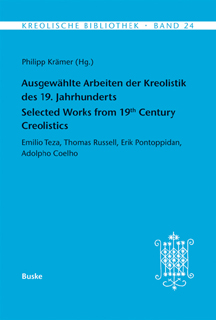
SCHAUMLOEFFEL, Marco Aurelio. Emilio Tezas Aufschlüsselung der Grammatik des Papiamentu. In: Philipp Krämer (Org.). Ausgewählte Arbeiten der Kreolistik des 19. Jahrhunderts / Selected Works from 19th Century Creolistics. 1ed.Hamburg: Buske, 2014, Kreolische Biblithek Band v. 24, p. 31-38.

Leseprobe: hPicturettps://buske.de/reading/web/?isbn=9783875486780

Webseite des Verlags:
http://www.buske.de/product_info.php?products_id=3881

Philipp Krämer (Hg.)
Ausgewählte Arbeiten der Kreolistik des 19. Jahrhunderts / Selected Works from 19th Century Creolistics
Emilio Teza, Thomas Russell, Erik Pontoppidan, Adolpho Coelho
Kreolische Bibliothek, Band 24. 2014. 184 Seiten. 978-3-87548-678-0.

Die Disziplingeschichte der Kreolistik ist noch lange nicht vollständig aufgearbeitet. Gerade im 19. Jahrhundert entfaltete sich ein neues Interesse für Kreolsprachen.
Dieser Band zeigt die ganze Vielfalt der Vorläufer des Faches: Vier bisher weniger beachtete Texte aus verschiedenen Ländern von ganz unterschiedlichen Autoren mit ihren eigenen Schwerpunkten können im Original und in deutscher Übersetzung neu entdeckt werden. Neben den Editionen beleuchten zu jeder historischen Arbeit jeweils zwei Kommentare von ausgewiesenen Fachleuten die Facetten der Quellen. Vom epistemologischen Erbe der Disziplin zur biographischen Vorstellung der Autoren, von der historischen Grammatik zur philologischen Bedeutung der Oralliteratur reichen die Fragestellungen, welche die heutige Kreolistik anhand älterer Texte angehen kann.

INHALT 

Vorwort …………………………………………………………………………………………… VII

Einleitung: Vier Kreolisten – und was ihre Arbeiten für die Gegenwart
bedeuten (Philipp Krämer) …………………………………………………………………. IX

Il dialetto curassese (Emilio Teza) ……………………………………………………….. 1

Der Dialekt von Curaçao (Emilio Teza) ……………………………………………….. 11

Emilio Teza: A Curious Genius and Nomad of Philology
(Roberta Pasqua Mocerino / Markus Lenz) ………………………………………….. 23

Emilio Tezas Aufschlüsselung der Grammatik des Papiamentu
(Marco Aurelio Schaumloeffel) …………………………………………………………… 31

The Etymology of Jamaica Grammar (Thomas Russell) …………………………. 39

Thomas Russell’s Grammar of “A Stubborn and Expressive Corruption”
(Don E. Walicek) ………………………………………………………………………………. 55

Thomas Russell’s Contribution to Historical Jamaican Grammar
(Joseph T. Farquharson) ……………………………………………………………………. 67

Einige Notizen über die Kreolensprache der dänisch-westindischen Inseln
(Erik Pontoppidan) ……………………………………………………………………………. 79

Det dansk-vestindistke kreolsprog (Erik Pontoppidan) ………………………….. 89

Die dänisch-westindische Kreolsprache (Erik Pontoppidan) …………………… 99

Dr. med. Erik Pontoppidan und das Negerhollands (Peter Stein) …………….. 109

Die kreolische Oralliteratur: eine Kultur des Widerstandes?
(Magdalena von Sicard) ……………………………………………………………………… 123

Os dialectos romanicos ou neo-latinos na África, Ásia e América
(Adolpho Coelho) ………………………………………………………………………………. 143

Die romanischen oder neulateinischen Dialekte in Afrika, Asien und
Amerika (Adolpho Coelho) ………………………………………………………………… 149

Die letzten Geheimnisse Adolfo Coelhos? (Sílvio Moreira de Sousa) ………. 157

Neither raça nor povo. Adolpho Coelho’s Particular Universalism
(Philipp Krämer) ………………………………………………………………………………. 175


Source: Marco

What do Aruba, Bonaire and Curaçao have in common with Malacca? The historical and linguistic links between Papiamentu and Papiá Kristang

Picture

Presentation – References

What do Aruba, Bonaire and Curaçao have in common with Malacca?
The historical and linguistic links between Papiamentu and Papiá Kristang


The Portuguese, West African and Brazilian Origins of Papiamentu

Picture

Abstract of presentation done at the 19th Biennial Conference of the Society for Caribbean Linguistics, Nassau, The Bahamas, 30 July – 3 August 2012

Source: http://www.scl-online.net/Conferences/Past/2012_abstracts.pdf  p. 58-9

SCHAUMLOEFFEL, Marco
The University of the West Indies, Cave Hill

The Portuguese, West African and Brazilian Origins of Papiamentu

The genesis of Papiamentu (PA) still is controversial and scholars explain it through different hypotheses. Amongst others, Maduro (1966) and Munteanu (1996) classify it as a Spanish creole, since the Spaniards were the first to colonise the ABC Islands, where PA is spoken today; Martinus (1996) and Jacobs (2009) defend the Afro-Portuguese roots of PA, which would be linked to the transatlantic slave trade, whereas Goodman (1987) claims that PA would trace back its origins to a Brazilian creole brought to the Caribbean by Sephardic Jews and their servants who immigrated from Dutch Brazil to Curaçao after the recapture of Pernambuco by the Portuguese.
Differently from previous studies, the aim of this paper is to show that both the Afro-Portuguese and the Brazilian
hypothesis are complementary and necessarily must be considered when investigating the origins of PA, namely the role of the Portuguese language in Africa and the Americas during the transatlantic slave trade, the historical links between the ABC Islands and West Africa, and between Curaçao and Brazil. After a century of unsystematic rule, the Spaniards abandoned the ABC Islands and declared them islas inútiles or useless islands. In 1634, the Dutch occupied Curaçao and expelled almost all Amerindians to Venezuela. Even if the handful remaining Caiquetíos would have spoken Spanish or a Spanish creole after the Spanish absence, this fact hardly could have been decisive in the formation of PA, given the high influx of people from West Africa and Dutch Brazil.
History alone obviously cannot be used as the only evidence to support the claim that PA can trace back its origins to Portuguese and the Portuguese Creoles spoken in Europe, West Africa and Brazil, but it certainly is a component that plays a vital role to understand its origins. In this context the historic links between West Africa, Brazil and the ABC Islands will be examined. Linguistic data is naturally the most reliable evidence.
The linguistic features that PA shares with Portuguese and creoles of Portuguese basis will be thoroughly analysed in a future paper. Shared linguistic features between Fá d’Ambô (Annobonese) and PA and Brazilian Vernacular Portuguese and PA will be the object of the study. Therefore, the historical component here investigated should only be considered the first pillar of a more extensive and complete study. Both components combined, however, certainly provide a broader and more comprehensive scenario as to why it may be possible to trace back the origins of Papiamentu to Portuguese and Creoles of Portuguese origin.
The evidence shows that the history of the formation of PA cannot be comprehensively analysed and understood if vital historical links to the Portuguese language, to West Africa and Portuguese Creoles spoken in Africa, and to the immigration of Sephardic Jews and their servants from Dutch Brazil to Curaçao are ignored. As result, this paper definitively refutes any hypothesis that excludes the fundamental role of Portuguese and Portuguese creoles in the formation of PA.

Empréstimos Lingüísticos do Português nas Línguas Faladas no País dos Tabons

Printed Article – Portuguese

Português – artigo separado
Empréstimos Lingüísticos do Português nas Línguas Faladas no País dos Tabons
Empréstimos Lingüísticos do Português nas Línguas Faladas no País dos TabonsEste artigo de 29 páginas investiga os empréstimos de palavras e expressões do português em algumas das diversas línguas faladas no Gana. Este fenômeno foi causado pela presença portuguesa naquela área, iniciada em 1471, e pelo fenômeno dos retornados vindos da Bahia, lá chamados de “Tabom people”, ocorrida no início do Século XIX. Disponível nos formatos impresso e arquivo eletrônico. 29.09.2011

Möglichkeiten und Grenzen des Computereinsatzes in brasilianischen Schulen

Book – German
Möglichkeiten und Grenzen des Computereinsatzes in brasilianischen Schulen
Möglichkeiten Und Grenzen Des Computereinsatzes In Brasilianischen SchulenDieses Buch analysiert die Möglichkeiten und die Grenzen des Computereinsatzes in Schulen, spezifisch im Bereich Deutsch als Fremdsprache.
ISBN 1-44046031-0   EAN 978-1440460319
Publication Date: Mar 30 2009
Page Count: 76
Categories: Language Arts & Disciplines / Linguistic

Interferenz des Portugiesischen im deutschen Dialekt von Boa Vista do Herval, Rio Grande do Sul

Picture

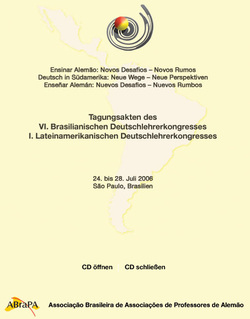
Artikel in den Tagungsakten des VI. Brasilianischen Deutschlehrerkongresses und des I. Lateinamerikanischen Deutschlehrerkongresses, São Paulo, Brasilien, 27.07.2006

“Deutsch in Südamerika: Neue Wege – Neue Perspektiven”

Inhaltsverzeichnis: http://www.abrapa.org.br/cd/beitrage.htm

Artikel
SCHAUMLOEFFEL, Marco Aurelio. Interferenz des Portugiesischen im deutschen Dialekt von Boa Vista do Herval, Rio Grande do Sul. In: I Congresso Latino-Americano de Professores de Alemão & VI Congresso Brasileiro de Professores de Alemão, 2006, São Paulo, Brasil. Tagungsakten des VI. Brasilianischen Deutschlehrerkongresses. São Paulo: Abrapa, 2006

http://www.schaumloeffel.net/textos/interferenz.pdf


Source: Marco